EMILY
HAU
“She reads the fine print.”

The speed-camera contract our town signed cites Florida statutes for data retention. This is Connecticut.
The Board voted on a three-year term. The signed contract says five.
Somebody has to read these things. I volunteer.
You don't have to like everything about me.
You just have to ask yourself one question: when the next bill crosses a desk in Hartford, who do you want reading it?
Paper beats noise. Every time.
Most people in Fairfield know me for one of two things: reading the fine print, and heating oil.
The research.
When our town signed a speed-camera contract, I read it — the whole thing. It cited Florida law instead of Connecticut law. Residents were told the cameras ran during school hours; the town's own FAQ said they ran around the clock. Nobody in Hartford caught it. Nobody at Town Hall caught it. A resident with a library card caught it.
The heating oil.
Five years ago I read my own heating oil contract, found the price wasn't a market price, and started buying as a group instead. It began with 117 households. It's now more than 900 families, and 88% come back every year. Same habit, different document.
Hartford is full of people who vote on things they haven't read, and then send us a newsletter about it. I read the bills. I read the contracts. And when what's written doesn't match what we were told, I say so — in public, with the documents attached.
I won't promise to be the most agreeable person in the building. I'll promise to be the most practical — and the most devoted to the people I represent.
Where I stand — plainly, and in detail.
I did my homework on the issues the way I do everything else.
Affordability
Everyone running for office says the word. Here's what I did about it.
Five years ago I read my heating oil contract and did the arithmetic. The price wasn't a market price — it was whatever the company thought I'd accept. Nothing stopped neighbors from buying together except that somebody had to read the fine print and run the bid.
So I did. It started with 117 families. Today the Nutmegger Oil Group is more than 900 households, I rebid the contract every June, and over four winters we’ve kept more than $1.6 million in our neighbors’ pockets — $2.70 a gallon this past March against a Connecticut average of $5.60.
That's not a slogan. It's a spreadsheet, and I'll show it to anyone who asks.
Disclosure: The oil company pays me to run the group. It's disclosed, it comes out of their margin rather than your gallon price, and I bid the contract out every year to whoever serves the group best.
Energy costs
Connecticut families pay some of the highest energy bills in the country, and I know this market cold. We need a true all-of-the-above supply strategy — keep Millstone and treat nuclear as clean, reliable power, advance the small modular reactors the state authorized in 2025, ease the winter natural-gas crunch, and pair solar with battery storage to cut peak demand. And we need real ratepayer protection: move the “public benefits” charges off your bill and into the state budget where they're justified on the record, give solar customers a bill of rights so nobody gets scammed, and require utilities to fix gas leaks when a road is already torn up.
Housing & local control
I want more housing — near the transit and infrastructure we already have — but built with communities, not imposed by one-size-fits-all mandates from Hartford. It should start with real data on what housing is actually needed, and where. Fix 8-30g's broken definition of “affordable” so towns get credit for housing that genuinely is affordable, and tackle the real cost drivers keeping people out: property taxes, permitting costs, and sky-high energy bills. I'm tired of politicians writing policy like they're pushing a website live just to see what breaks — maybe this will work, whoops, no, let's experiment a little more. It isn't a simulation. Real people, real consequences.
Schools & kids
Fully fund the Education Cost Sharing formula and index it to inflation so towns aren't stuck filling the gap with property taxes. Get K-3 literacy right with evidence-based, phonics-driven reading and real funding for reading specialists — and less time on Chromebooks. Protect special-education students, an area close to both my heart and my research, and expand vocational-technical education and community college so a four-year degree isn't the only path to a good career.
Environment & open space
Protect our open space and tree canopy — a mature tree is one of the cheapest flood defenses we have. I support a three-for-one replacement standard for any tree removed, and I'm currently working with a Yale Data Science Fellow and Yale School of the Environment faculty to actually measure how much flooding we can expect as we pave over open ground. Real climate solutions, yes — but ones we can afford and actually deliver.
Getting around
Faster, more reliable Metro-North isn't just convenience — it grows our tax base and pulls cars off I-95. Fix the gap where the state funds road projects but can't deliver them, thanks to weak oversight and slow contracting, and protect the Special Transportation Fund by making heavier EVs pay their fair share for the roads they use.
Health care
Keep private equity from running our hospitals into the ground, and streamline the Certificate of Need process. Raise the Medicaid reimbursement rates that have been underfunded for two decades, invest in urgent, primary, and hospice care outside the hospital, and let small businesses pool together through association health plans for more affordable coverage.
Taxes & spending
The fiscal guardrails have helped Connecticut pay down crushing pension debt and earn credit-rating upgrades — I'd protect that discipline. But I'm pragmatic, not rigid: I'm open to fairer, more modern tax models and real tax relief for middle-class families, and I'll oppose quietly weakening the caps just to unlock more spending with nothing to show taxpayers for it.
Accountability & transparency
Residents shouldn't have to file a records request to find out what their own government decided. I've spent years doing exactly that, and the pattern is always the same: the document exists, nobody volunteered it. I'd strengthen the Freedom of Information Act instead of quietly carving holes in it — real deadlines with real consequences, no fee walls on ordinary requests, agendas and backup materials posted before the meeting rather than after, and video of public meetings kept where the public can actually find it. Add easier ballot access, a stronger Citizens' Election Program so newcomers can run without a built-in donor network, and a more direct say for voters.
Surveillance & your data
License-plate readers, school-zone cameras, and the contracts behind them are being bought across Connecticut with very little public discussion. Nobody's asking for the nuclear codes — we're asking what a system is for, how many are going in, who can query the data, how long it's kept, and who else gets it. When a town spends millions of tax dollars on equipment that tracks residents' movements, a public hearing before the purchase should be the floor, not a favor. I'd require plain-language impact statements and retention limits in statute, and hold the state to the same standard I'm asking of Fairfield.
Homeschooling & parent-directed education
Connecticut families have a fundamental right to direct their children's education, and the state has a real duty to protect children from harm. Those two things aren't in conflict, and good policy shouldn't pretend they are.
Public Act 26-37 asks every family to file an annual form on how their child is educated, and it requires a DCF check when a family withdraws a child to begin homeschooling. I support keeping children safe. My concern is narrow and specific: the law permanently bars a family from homeschooling if a parent appears on the state's child abuse and neglect registry — a listing an agency makes on a “reasonable cause to believe” standard, not a finding made by a court — and the recourse it offers a family placed under that bar is minimal.
A permanent restriction on a constitutional right should rest on more than an administrative finding, and every family subject to one deserves a real, workable appeal.
The way this passed should also give people pause, wherever they land on the policy itself. Public opposition ran heavily against the bill, and it advanced out of committee only after recorded “no” votes were changed during the voting window. Residents who take the time to show up deserve to be heard, not overridden.
I'd protect children through fair process: judicial findings rather than registry listings as the basis for restricting a family's rights, and a clear appeal for any parent told they may not educate their own child. That's a standard that keeps kids safe and treats families fairly at the same time.
Eight bills. I’ve already written the case for every one.
Most candidates give you values. Here is legislation. Every one of these came out of a document I read — a contract, a filing, or a formula that didn’t hold up when somebody finally checked it. Some of them will cost me votes. They’re here anyway.
Ban per-citation payment to camera vendors
Fairfield's $15 surcharge on every citation is the vendor's compensation — their revenue rises with the number of tickets written. Whatever you think of the cameras, no safety program should be built so the contractor profits from more violations. Flat contracted fee only, written into statute.
Put a clock and a ledger on the appeals
Our hearing officer is paid $250 an hour with more than a thousand appeals pending. The state authorized this program without building the capacity to adjudicate it. I'd set a statutory deadline for a hearing, void the citation if the town misses it, and require every town to publish gross revenue, vendor payments, and adjudication costs once a year. Right now nobody in Connecticut can tell you the net. That isn't an accident.
Rate notices a person can read
Aquarion asked for roughly 42 percent. The WPCA is moving sewer rates now. In both cases the filing is public and effectively unreadable, and the hearings are held when working people can't attend. I'd require a plain-language notice mailed with the bill showing the dollar effect on a typical household, and at least one evening hearing in the affected service area.
A petition-triggered local referendum on speed cams
If a town's voters want to decide whether cameras go up, state law should let them — by petition, before the ordinance takes effect. I'll file that bill. Note what it is and isn't: it hands the decision to residents rather than to me, and I'll file it whether or not I expect to like the result.
Make somebody actually check the affordable units
Sixteen condominiums were approved on Westway Road in Southport in 2017, two of them deed-restricted as affordable for forty years. The affordability plan named the developer as the person responsible for verifying that buyers qualified. He sold the first restricted unit to himself and the second to his business partner's son, and filed the required annual compliance reports on both sales. The reports as filed listed household incomes above the applicable limits, and the Town's own counsel now says they showed noncompliance on their face. The first enforcement order came in 2024, the notices of violation this past January, and the appeals are pending — so nothing is adjudicated, and I'm not going to pretend otherwise.
Make the state show its work on housing numbers — the “fair share” formula
The state paid a consultant $255,000 to produce town-by-town housing allocations. Fairfield's draft number is 1,990 units. The formula is four variables weighted equally, because nobody could justify weighting them any other way, and not one of the four measures whether housing can physically go somewhere — no sewer capacity, no buildable land, no flood zone. Bridgeport's allocation is zero under one version of the formula and 6,813 under another. That's not a measurement; it's a choice with arithmetic on top. OPM has to finish this assessment by December 2026, so the legislature seated in January is the one that reviews it. I'd require any model used for a state mandate to publish its weights and sensitivity analysis, include physical constraints, and come back for a legislative vote before it binds a single town.
In any data science course, this model would come back marked up: four inputs, equal weights because nobody could defend any others, no published test of whether the answer holds up, and a result that swings from zero to 6,813 depending on which version you run. That's what's about to decide Fairfield's number.
Amend the homeschool law before it takes effect
This one will cost me votes and I'm telling you about it anyway. It passed the House 96 to 53 and takes effect July 1, 2027. It conditions a parent's decision on whether any adult in the household has an open DCF investigation — not a finding, not a court determination, an open file, which means only that someone made a call, with no appeal path and no deadline written into the law. Thousands of families came to Hartford to say so and were told it sounded reasonable. It does sound reasonable, which is exactly how a thing like that passes. I'd require an adjudicated finding rather than an open case, write in an appeal with a clock, cap what the new annual form's data can be used for, and restore the provision letting homeschooled students take classes and play sports at the schools their parents' taxes fund. That provision was in the bill and was stripped out to get it passed.
Require a warrant before government buys your phone's location
As of October 1, Connecticut bans selling your precise location — then exempts sellers who "cooperate with law enforcement." Nothing happens to the agency that buys it, and nothing keeps that data out of court. Montana closed this gap in 2025. I'd file a bill requiring a warrant before any government agency buys, licenses, or subscribes to location data, directly or through a vendor, and keeping illegally obtained evidence out of court.
Two of these — the affordable-unit certification and the housing formula — point at the same thing. The paperwork existed. It was filed on time, to the right office. Nobody read it. I'd extend the certification duty to for-sale and locally approved units, require a standard format that can be checked against the income limits, keep household data confidential while publishing town-level totals, and bar a developer and his affiliates from both administering affordable units and buying them.
I built a sourced timeline of how Fairfield's school-zone speed cameras actually came to be.
Put together entirely from the town's own agendas, minutes, meeting videos, and contract records. Every claim links to a source you can check yourself.
I've been documenting this town's decisions in public, one record at a time.
Everything below ran under my name in Patch and the CT Mirror — much of it before I was a candidate, and all of it built from the public record. Nobody has disproven a fact in any of it.
How Fairfield's zoning decisions actually got made.
Thirteen pieces built from the town's own agendas, minutes, and meeting video. The TPZ Vice Chairman responded to the series and did not dispute a single point.
Bringing people together to solve problems too big for any one person.
Emily Hau is the candidate for State Representative in Connecticut's 132nd District — Fairfield and Southport. She appears on the ballot twice: on the Republican line and on the Independent Party line. Cross-endorsement means a vote on either line is a vote for her.
The clearest picture of how I work is right here in Fairfield. The Nutmegger Oil Group now brings together more than 900 families, and by pooling our purchasing power we've kept over $1.6 million in local pockets over four winters. It's a small idea with a big lesson, and it's the whole reason I'm running: when people cooperate instead of going it alone, ordinary families win real savings against rising costs.
I've spent two decades at Yale University, recruited into three of its research organizations with growing responsibility at each. I started at the Yale Child Study Center, where I developed a lasting research interest in autism and special education; I went on to direct programs and partnerships at the Yale Institute for Network Science; and today I run the day-to-day operations of the Yale Institute for Foundations of Data Science — one of the university's top research and funding priorities — where I convene collaborators as varied as Google Research, the National Science Foundation, and the Boston Red Sox. With graduate training at Columbia and Yale, I'm especially good at winning grants and building programs that fund themselves through partnerships — exactly the kind of resourcefulness a representative should bring home to the district. My interest in autism and special education also led me to co-found the Give Speech Foundation, an earlier nonprofit effort to make communication technology more accessible for people who can't speak.
My approach to Hartford is plain: be optimistic, be cooperative, work across the aisle, and always put Fairfield first. And I make one promise I mean literally — I'll read the bills. No autopilot, no partisan reflex, no rubber-stamping legislation nobody's examined. Just careful, independent judgment on behalf of the people I represent.
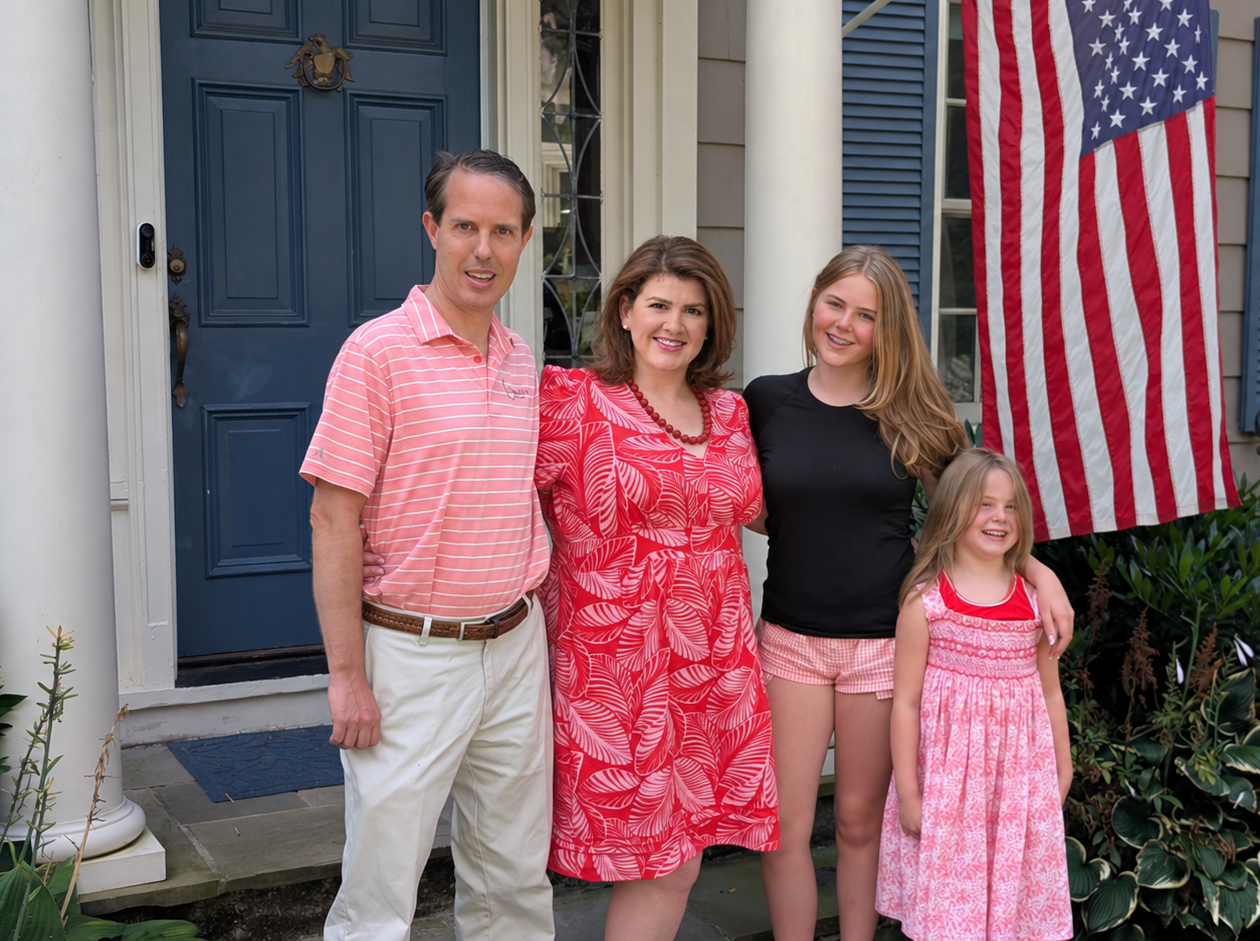
A Fairfield resident since 2015, I live in the district with my husband, William, and our two daughters.
BA in Geography, Ohio Wesleyan University · International business law study in Paris · Postgraduate fellowship in developmental social neuroscience, Yale School of Medicine · Graduate study in fundraising management, Columbia University.